Go From Dreading Every Conversation To Handling It Like A Professional
When their brain can no longer process logic, you can't argue. You redirect.
What's Inside:
- The "Refusals" Pack: Exact words for when they won't shower, won't eat, or won't take meds.
- The "Aging Brain" Protocol: When they don't recognize you, accuse you of stealing, hallucinate, or ask for someone who died.
- The "Keys" Trick: How to stop them from driving — without you being the villain.
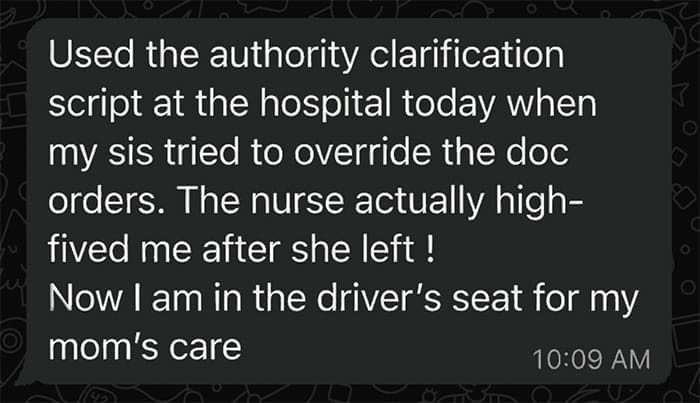
- The "Sibling" Smackdown: When they won't help, won't pay, or won't visit — so you finally stop doing it all alone.
- The "Guilt" Eraser: Self-talk scripts to stop feeling like a bad daughter when false guilt sets in.
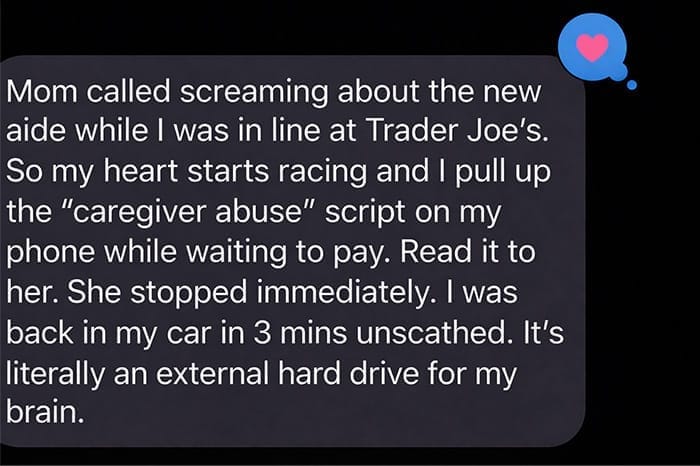
- The "Loop" Breaker: Handle repetitive questions ("What time is it?", "I want to go home") without losing your mind.
- The "Marriage Saver" Pack: Scripts for when caregiving is killing your relationship.
- The "Workplace Shield": Scripts for your boss, HR, and coworkers.
- The "Paid Help Manager": Scripts for hiring, firing, and holding aides accountable.
Stop Improvising. Start De-Escalating.
The "Hygiene Pivot"
Don't Say: "Mom, you smell. You need to shower
now."
(Result: Shame, anger, refusal.)
Say This Instead: "Oh gosh Mom, I'm so clumsy. I just spilled coffee all over the back of your shirt. I am so sorry! Let's get that off you quickly before it stains."
Why it works: It makes YOU the problem (clumsy) and HER the helper (letting you fix your mistake). It removes the shame of "being dirty."
What You're Getting:
- The Complete Crisis Deck — 100+ scripts across 14 categories
- 4 Bonus Resources — Capacity Worksheet, Extinction Burst Guide, Hiring Navigator, Script Customization Guide
- Lifetime Updates — receive all future updates to the Crisis Deck for FREE
LAUNCH SALE — Limited Time
Less than one hour of respite care.
Less than one co-pay.
Less than the gas you'll burn driving to a support group that tells you to "set boundaries."
Get The Crisis Deck NowIf these scripts don't work for you for ANY reason, email us for a full refund. No questions asked. Either get results or your money back.
Why You're Currently Losing The Fight
It's 4:00 PM. Your parent is refusing to shower. They say they showered this morning (they didn't). You try to reason with them. You show them the dry towel. You argue. They scream. You cry.
The problem isn't you. The problem is that you're using logic on a brain that is losing logic.
Path A: Keep improvising. Keep arguing. Keep losing. Keep watching your health, your marriage, your sleep, and your sanity erode — and wondering if this is what the next 5 years looks like.
Path B: Stop acting like a "Daughter." Start acting like a "Care Manager." Use environmental controls and therapeutic scripts designed by professionals who understand the aging brain.
This page is for people who choose Path B.
Picture Tomorrow Morning:
They refuse to get up. Refuse to eat.
You can either:
A) Improvise. Fight. Cry. Repeat.
B) Instead of your heart racing, you calmly find the "Refusals" script and read the words that hundreds of other caregivers have used to get through this exact moment. You manage the situation like a professional.
Quick Answers
"How do I access the Crisis Deck?"
Once you download, you'll get instant access. Start using it right away on your device or print the pages you need.
"Won't this sound scripted?"
Does a paramedic sound "fake" when they are saving a life? No. They sound calm and in control. When you use these words, you are speaking to the part of their brain that is still listening. It doesn't sound robotic to them; it sounds like safety.
"What if they push back even harder?"
Every script includes escalation follow-ups. The first response isn't the hardest — the second and third are. You'll have those too. Including what to do when they go silent, get angry, play victim, or recruit other family members to pressure you. The scripts assume pushback. They're built for it.
"My situation is too complicated for generic scripts."
The scripts are organized by relationship dynamic — for example, not just "sibling" but specific types: the Golden Child, the One Who Lives Far Away, the One Who "Can't Afford" To Help, the One Who Criticizes Your Care. This applies to all the script categories.
"I've tried everything. Why would this be different?"
Because you've been trying to use logic with a brain that can no longer process it. These scripts don't rely on logic. They rely on redirection & de-escalation — they stop asking your parent to understand and start helping them feel safe. You haven't tried this yet.

Sarah Mitchell
I built the Crisis Deck because I needed it first. When I became my mother's caregiver, I had no training, no scripts, and no idea why everything I said made things worse. A hospice nurse finally showed me what I was doing wrong — and the specific words that actually worked. I've spent years compiling those scripts so you don't have to learn them the way I did: alone, in tears, at 2 AM.